Mortgage Amortization Explained: Why Your Early Payments Are Mostly Interest
A visual, plain-English guide to how amortization works — and why the first 10 years of a mortgage feel like treading water.
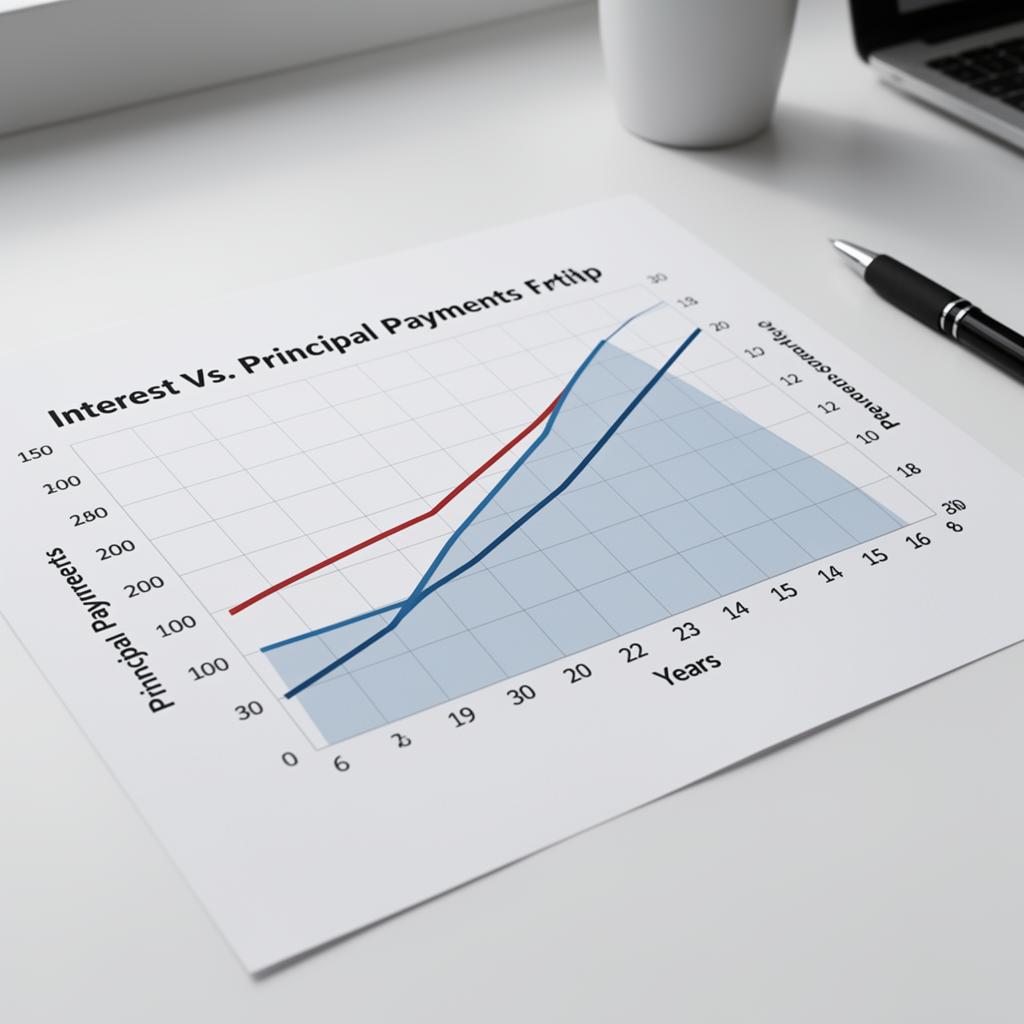
The most demoralizing moment in homeownership is looking at your mortgage statement after five years of payments and seeing that your balance has barely moved. You're not imagining it. Amortization is designed so that early payments are almost entirely interest. Understanding why this happens — and how to flip the script — changes everything about how you approach your loan.
What amortization actually means
Amortization is the mechanical process of paying off a loan through equal periodic payments. Each payment is the same amount, but the ratio of principal to interest changes every single month. The lender calculates interest on the remaining balance, takes that amount from your payment, and applies the rest to principal. Early on, the balance is high, so interest dominates.
The brutal first decade
On a $400,000 mortgage at 6.8% for 30 years: Year 1 total payments are $31,344. Of that, $27,100 is interest and only $4,244 is principal. You've reduced the balance by 1%. Year 5: $27,400 interest, $3,900 principal. Year 10: $25,800 interest, $5,500 principal. You don't reach the halfway point on the balance until roughly year 22.
The tipping point
The crossover — where principal finally exceeds interest in a given payment — happens around month 190, or year 16. After that, each payment accelerates the balance reduction. The last 5 years of a 30-year mortgage pay down more principal than the first 15 combined. This is why early extra payments matter so much: they front-load the balance reduction and pull the tipping point earlier.
Why lenders love 30-year loans
In the first 10 years of a $400,000 loan at 6.8%, the lender collects $267,000 in interest while the balance drops just $48,000. If you sell or refinance in year 7, the lender has earned two-thirds of the total interest on a loan that's barely been touched. This is not a conspiracy — it's just math. But it means that staying in a 30-year loan without acceleration is extraordinarily expensive.
How to beat amortization
Extra principal payments break the amortization curve by reducing the balance that future interest is calculated on. Even small additions reshape the schedule. $200 extra per month on the $400,000 loan moves the tipping point from year 16 to year 10. The earlier you start, the more dramatic the impact.
Generate your own amortization chart and watch the tipping point move as you add extra payments. See principal, interest, and balance year by year.
Visualize Your AmortizationThe amortization schedule as a tool
Your servicer can provide a full amortization schedule — a month-by-month breakdown of every payment for the life of the loan. Study it. Circle the months where principal finally exceeds interest. That's your motivation. Every extra dollar you send moves that circle to the left.
Visualize your own amortization
The Mortgage Payoff Calculator generates a year-by-year amortization chart showing principal, interest, and remaining balance. Add extra payments and watch the curve change. Seeing the tipping point move closer is one of the most motivating financial visuals you'll ever encounter.
Get more guidance like this in your inbox
Weekly emergency-fund tactics, milestone checklists, and the next article — delivered free.
Plan your mortgage-free date
See exactly when you'll be mortgage-free and how much interest you'll save with your extra payments.
Open the Mortgage Payoff Calculator