How Much Sod Do I Need? (Rolls, Pallets, and Waste)
The formulas for sod rolls, pallets, and 5–10% waste factor by yard shape.
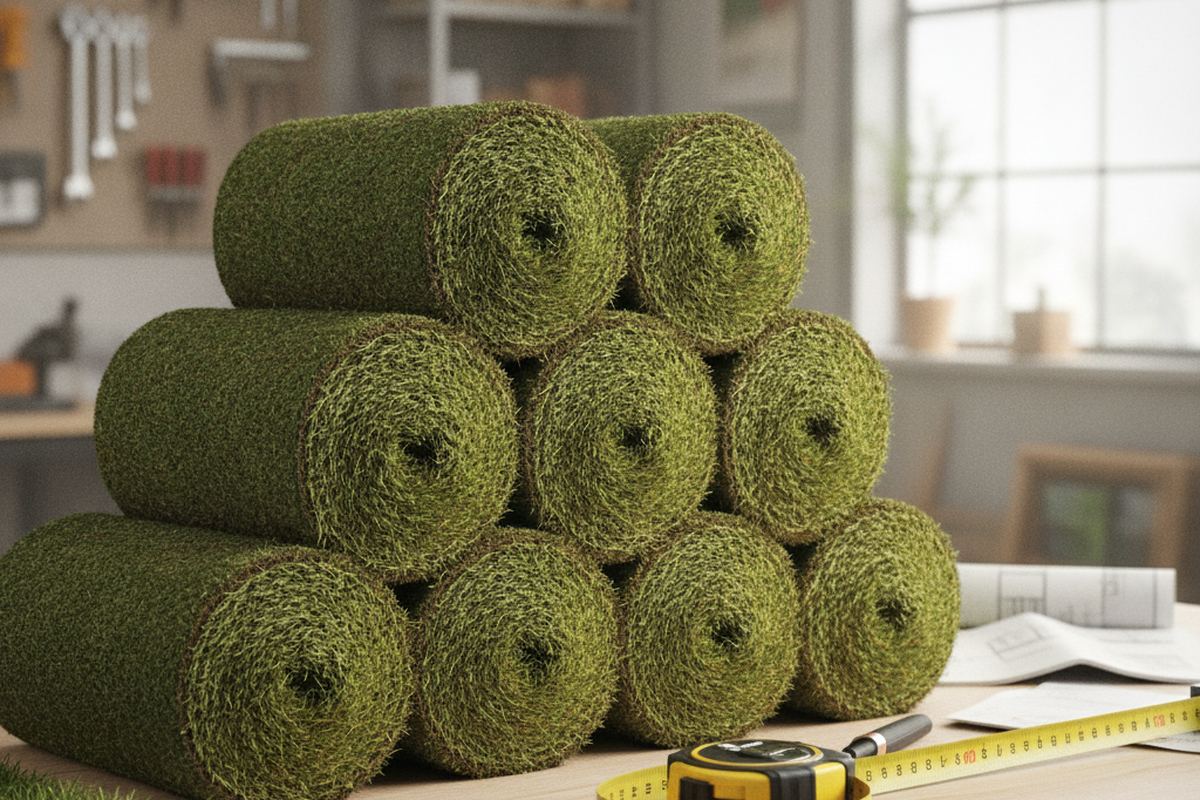
Determining the correct amount of sod for your landscaping project is crucial for both budget and successful installation. Ordering too little can lead to delays and mismatched grass, while ordering too much results in unnecessary waste and expense. This guide will walk you through the precise calculations needed, considering different sod forms and common project variables. Understanding these factors ensures you acquire just the right quantity for a lush, new lawn.
Accurately Measure Your Lawn Area
The first step in calculating your sod needs is to accurately measure the area you intend to cover. For simple rectangular or square yards, multiply the length by the width to get the total square footage. For more complex shapes, it's often easiest to break the area down into smaller, manageable rectangles and squares, calculate each section, and then sum them up.
For circular areas, measure the radius (distance from the center to the edge) and use the formula πr² (pi times radius squared). For triangular sections, use (base × height) / 2. Don't forget to account for any existing structures, pathways, or garden beds that will not be covered by sod, subtracting their area from your total measurement.
Understanding Sod Roll Dimensions
Sod is typically sold in rolls, although dimensions can vary slightly by supplier. The most common size for residential projects is a roll measuring 2 feet by 5 feet, covering 10 square feet per roll. Some suppliers may offer larger rolls, such as 2 feet by 8 feet (16 square feet) or even smaller ones like 1.5 feet by 6 feet (9 square feet). Always confirm the exact dimensions with your supplier before making any calculations.
Once you have your total square footage and the square footage per roll, divide your total area by the coverage of a single roll. For example, if you have 1,000 square feet to cover and each roll covers 10 square feet, you would need 100 rolls (1,000 sq ft / 10 sq ft/roll). This provides a base number before accounting for waste.
Calculating Sod Pallet Requirements
For larger projects, sod is often sold by the pallet. Pallet sizes are not standardized and can vary significantly based on the sod farm and region. A common pallet size might contain anywhere from 400 to 500 square feet of sod. Some larger pallets could hold up to 600 or even 700 square feet. It is critical to confirm the exact square footage per pallet with your chosen sod provider.
To determine how many pallets you need, take your total square footage requirement (including waste factor, discussed next) and divide it by the square footage per pallet. For instance, if you need 1,200 square feet of sod and each pallet covers 500 square feet, you would need 2.4 pallets. Since you can't order a fraction of a pallet, you would round up to 3 pallets to ensure full coverage.
Estimate sod pallets, rolls, and total install cost for your yard — with delivery and prep budget.
Open the Sod CalculatorAccounting for Waste Factor by Yard Shape
Even with careful measurement, some waste is inevitable during sod installation due to cutting and shaping around obstacles. It's standard practice to add a waste factor to your total calculated area. For simple, rectangular yards with few obstructions, a 5% waste factor is generally sufficient. This means multiplying your total square footage by 1.05.
For yards with irregular shapes, numerous curves, or many obstacles like trees, garden beds, or pathways, a higher waste factor of 10% is recommended. Multiply your total square footage by 1.10 in these cases. This buffer ensures you have enough material to complete the job without running short and needing a costly, time-consuming reorder.
- Simple, rectangular yards: Add 5% waste.
- Irregular shapes, curves, or many obstacles: Add 10% waste.
Example Calculation for a Complex Yard
Let's consider a yard with a total measured area of 1,500 square feet, which includes several curved beds and a few mature trees. Given its complexity, we'll apply a 10% waste factor. First, calculate the adjusted area: 1,500 sq ft * 1.10 = 1,650 square feet. This is the amount of sod you should aim to purchase.
If your supplier sells sod rolls that are 2 feet by 5 feet (10 square feet per roll), you would need 165 rolls (1,650 sq ft / 10 sq ft/roll). If the sod is sold on pallets covering 500 square feet each, you would need 3.3 pallets (1,650 sq ft / 500 sq ft/pallet). In this scenario, you would round up to 4 pallets to ensure you have enough material.
Understanding Sod Delivery and Logistics
Beyond the quantity, consider the logistics of receiving your sod. Sod is a perishable product and should be installed within 24 hours of delivery, ideally sooner, especially in warm weather. Plan your delivery for a day when you are fully prepared to lay it immediately. Ensure you have adequate manpower or equipment to move the heavy rolls or pallets.
Confirm delivery access with your supplier. Pallets are often delivered by forklift to a paved surface. If your installation area is not easily accessible, you'll need to arrange for transportation of the sod from the drop-off point to the work site. Discuss these details beforehand to avoid last-minute complications.
The bottom line
Careful measurement and accurate calculations are the foundation of a successful sod installation project. By understanding sod dimensions, applying an appropriate waste factor, and planning for delivery, you can ensure a smooth process. Taking these steps will help you achieve a beautiful, healthy lawn efficiently and within budget.
Get more guidance like this in your inbox
Weekly emergency-fund tactics, milestone checklists, and the next article — delivered free.
Run your own number
Get a personalized emergency fund target based on your income, expenses, and job stability.
Open the calculator